Client Name
Industry
Food & Beverage
Location
Qathet Regional District of B.C.
Client Size
Small
Website
Services Offered
Challenge
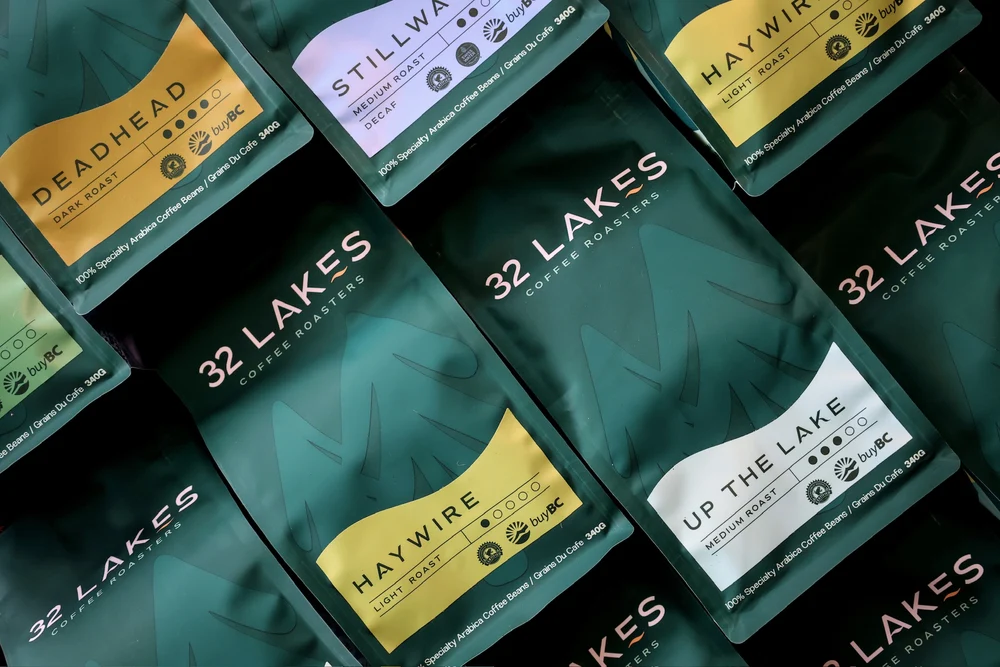
32 Lakes Coffee Roasters is a small-batch specialty roastery located in the Qathet Regional District of B.C., operating on the territory of the Tlaʼamin Nation. Sustainability is central to how the business operates, from the delivery partners they choose to the way they manage their facility.
In 2020, 32 Lakes decided to measure its greenhouse gas (GHG) emissions with Synergy. The business wanted to understand the emissions impact of its operations, confirm that its choices were having a measurable effect, and back up their environmental commitments with real data. For a small roaster competing in a market dominated by larger companies, the ability to point to a credible transparent record of people and planet-centered operations sets 32 Lakes apart.
Synergy’s Solution
The Annual GHG Inventory
The foundation of Synergy’s work is annual GHG inventories. A structured, year-over-year measurement of all material emissions from a company’s operations. Material emissions include sources over 5% of total footprint, while immaterial emission sources make up less than 5% of the total footprint, cumulatively. 32 Lakes has now completed six consecutive years of measurement and is a perfect example of what this process looks like:
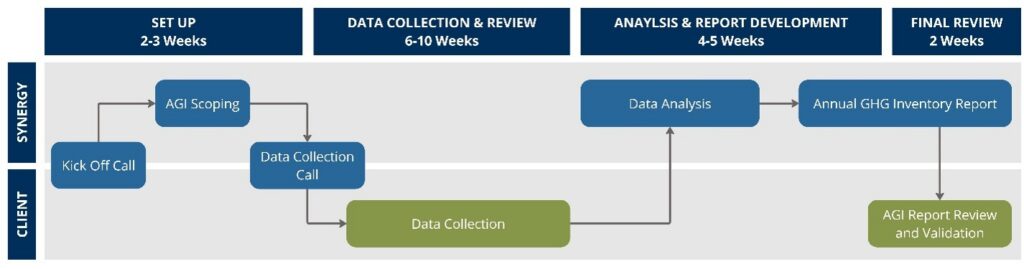
Step 1: Boundary Setting & Scoping Assessment
In the first year of a GHG inventory, Synergy conducts a full scoping assessment to understand the business and identify all relevant emissions sources. This involves a one-hour conversation with the business to understand the company’s operations: what it does, how it operates, and its value chain. From that, Synergy determines which activities should be included in the inventory and what data will be needed to measure them. There are 3 scopes of emissions outlined by the GHG protocol:
Scope 1: Direct emissions from owned/controlled sources (ex. Natural gas combusted onsite, fuel purchased for company vehicles)
Scope 2: Indirect emissions from purchased energy (ex. Electricity, heat or steam purchased from a third party like a utility supplier)
Scope 3: All other indirect emissions in the value chain, grouped into 15 categories (ex. employee commuting, waste produced from company operations, company purchases, etc.)
For 32 Lakes, the relevant emission sources include:
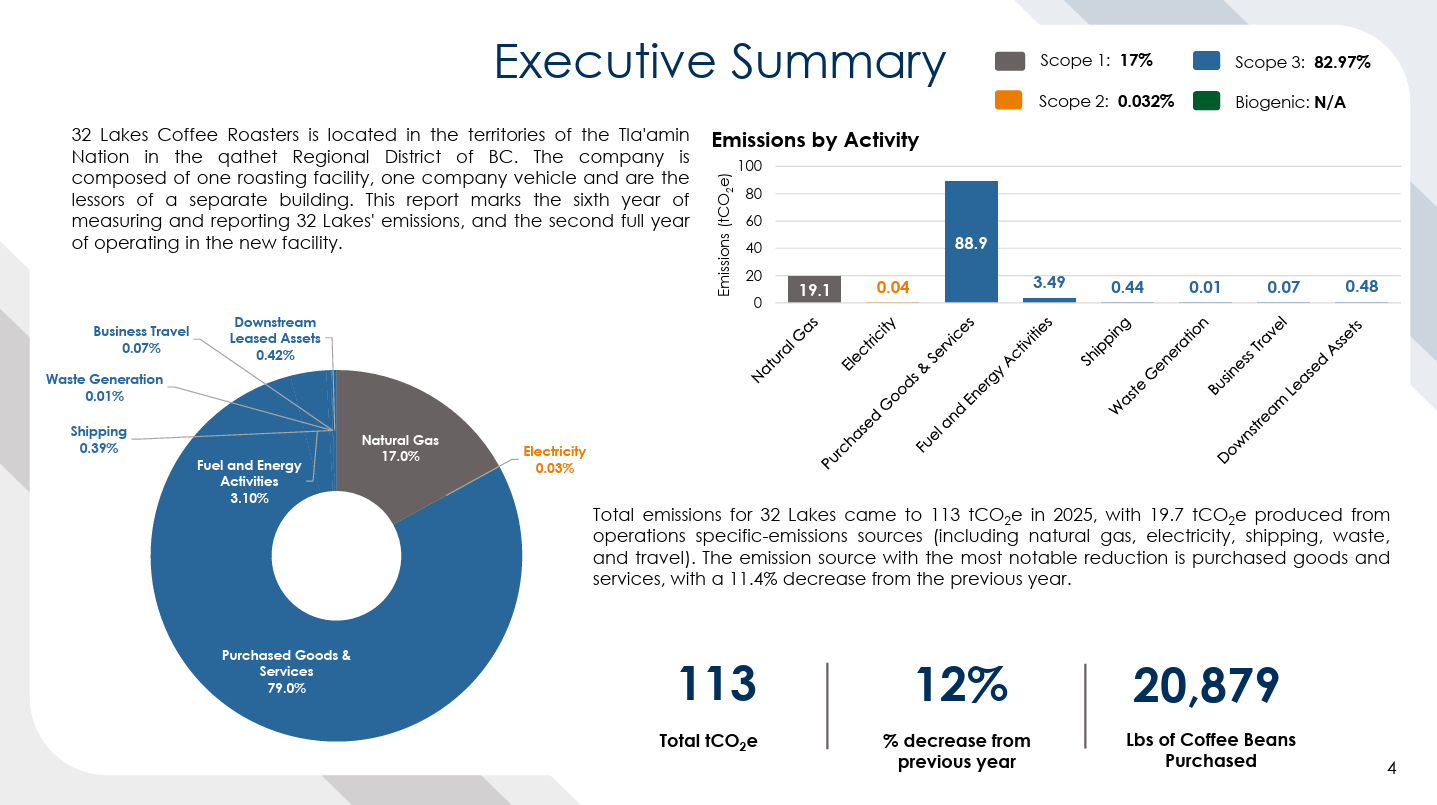
- Scope 1: Natural gas used for roasting coffee beans and the afterburner, and fuel consumption for company vehicles (now eliminated following the switch to an EV)
- Scope 2: Electricity at the roastery
- Scope 3: Business travel, shipping, waste, and the downstream emissions from the café space they lease.
In 2024, the scope was expanded to include purchased coffee beans, a significant addition that better reflects a coffee roaster’s full footprint and aligns with industry best practices.
The scoping step matters because not every emission source is equally relevant or measurable for every business. Synergy’s job is to determine what’s material to your operations, set a clear boundary, and build a consistent methodology that makes year-over-year data meaningful.
Time needed from client: 1-2 hours for the scoping assessment meeting
(Depends on client size)
Step 2: Data Collection
Once the scope is defined and emission sources have been identified, Synergy creates a customized data-tracking sheet and works with the 32 Lakes team to gather the necessary data. For most businesses, the data already exists in the form of utility invoices, fuel receipts, shipping records, and more. The team at 32 Lakes typically invests about 5 to 10 hours over a 3-week period to collect data. Synergy provides support throughout and adapts when primary data isn’t available, using credible alternative methods to estimate activity data.
One of the things that makes this process work for a small operation like 32 Lakes is that Synergy adapts to the client’s systems, working with the available data to deliver the most accurate results possible while placing the least burden on the team.
Time needed from client: 5 – 10 hours
Step 3: Emission Calculation and Analysis
With data collection completed, Synergy applies emissions factors from credible, peer-reviewed sources to convert activity data into tonnes of carbon dioxide equivalent (tCO2e), the standard unit for measuring greenhouse gas emissions across different gases and sources. Synergy’s proprietary calculation tool follows the methodology of the GHG Protocol, the globally recognized standard for corporate emissions accounting.
After calculations have gone through a technical review process, a visual report is produced that breaks down the company’s emissions by scope and source, tracks year-over-year changes, highlights the top emission sources, and contextualizes the results within the company’s reduction targets and decarbonization priorities.
Step 4: Review
Synergy presents the final report to the 32 Lakes team in a one-hour meeting. This is an opportunity to walk through the findings together, discuss what’s driving changes in the numbers, make any edits, and confirm that the report accurately reflects the year’s operations before it’s finalized and published.
Synergy’s reports are designed to be visually forward, easy to comprehend, and tell a story using data. Reports are tailored to the client’s use case, using KPIs, custom graphs, and informed analysis to provide useful insights into emissions and company operations.
Time needed from client: 1-2 hours
Each subsequent year follows the same process, but with the benefit of accumulated data. The data collection process becomes more efficient as the team knows what’s needed and where to find it, and Synergy builds processes to streamline data collection. Year-over-year comparisons become more insightful, and reporting becomes more meaningful as patterns emerge over time.
From Offsetting To The Climate Action Partner Program
In their first few years of reporting, 32 Lakes purchased carbon offsets to neutralize its carbon impact, a common practice at the time that demonstrated climate action leadership. However, as the broader conversation around climate action evolved, the focus shifted from measuring and offsetting emissions to prioritizing decarbonization. To remain a leader in the space, 32 Lakes wanted to move beyond offsetting and toward genuine, measurable decarbonization.
In September 2025, 32 Lakes joined the Synergy Climate Action Partner (CAP) Program to further their climate action.
The CAP program was developed in response to evolving regulations around sustainability claims and carbon offsetting, which, though a useful interim tool, is not a decarbonization strategy. The CAP program provides a structured five-phase framework (Commit, Measure, Plan, Implement, Lead & Influence) for organizations that are ready to move from measuring their footprint to actively reducing it, transparently and accountably.
As a CAP partner, 32 Lakes has publicly signed a commitment policy, disclosed its annual GHG inventory results on a public-facing partner page, and documented its ongoing emissions-reduction initiatives.
Implementation and Results
Emissions Reduction Initiatives
Annual measurement has given 32 Lakes the data to understand its generated emissions and to track the actual impact of operational changes over time. Over the course of the reporting period, the company has implemented a range of initiatives:
- Electric Vehicle: 32 Lakes purchased an EV in 2022 to replace their gas-powered vehicle for business operations and local deliveries, eliminating fuel emissions from scope 1 and reducing emissions by 4.8 tCO2e in 2023 compared to the prior year
- Low-Carbon Shipping: BC-based deliveries are made through lower-emission providers, including Geazone, reducing the company’s shipping footprint
- Afterburner: The addition of an afterburner to the roasting equipment reduces smoke and scent emissions during the roasting process
- Facility Upgrades: Upgrades at the roastery, including insulation and adding a pedestrian door to the warehouse entry, reducing the energy needed to heat the space
Key Takeaways
The GHG Inventory Process
For businesses considering GHG measurement for the first time, 32 Lakes is a useful example of what the process looks like in practice. The first year requires the most time commitment and becomes more efficient, insightful, and easier each year as data collection becomes more systematic. Synergy handles the methodology, calculations, and report, and the client provides an understanding of their own operations and the data already in their systems.
Continuous Measurement Creates Operational Insight
A single GHG inventory gives you a snapshot. Six years of inventories give you a story. 32 Lakes can now see exactly how its emissions have changed as they’ve grown, moved facilities, switched to an EV, expanded the scope of its reporting, and made operational adjustments year over year. That’s the kind of insight that makes decarbonization planning grounded in reality. When a change gets made, the next year’s report tells you how it worked.
Small Organizations Can Lead
32 Lakes is a small business, but it’s been measuring and publicly disclosing company emissions since 2020. 32 Lakes has made the jump from offsetting to genuine decarbonization, expanded the scope of its reporting to include supply chain, and joined a public accountability program. The GHG inventory process is designed to be scalable: the same four-step methodology applies to a two-person roastery and a large corporation. For 32 Lakes, that means it gets the same rigorous, credible measurement that its much larger peers use at a scope and cost that fit 32 Lakes’ size.
A Multi-Purpose Report
32 Lakes began measuring to understand their impact and support their offsetting commitments. Over time, the report has also served as a tool for tracking the effectiveness of carbon reduction initiatives, communicating their environmental performance publicly, and demonstrating that their sustainability claims are backed by data.
If your business is ready to measure its emissions, understand its footprint, and build a credible path toward decarbonization, contact us to learn how we can help.