Client Name
Kelowna International Airport (YLW)
Industry
Aviation
Location
Kelowna BC
Client Size
Large
Website
Services Offered
- Solar Pre-Feasibility Assessment
- Funding Research
Challenge
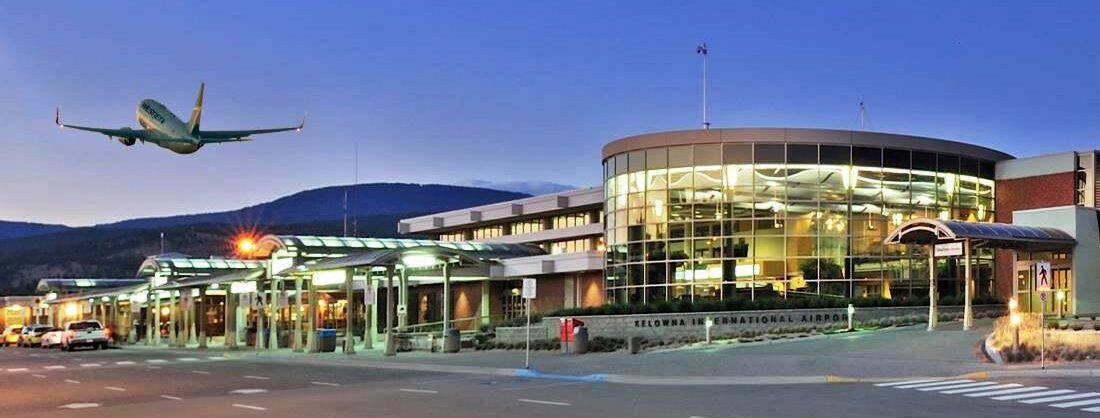
Kelowna International Airport (YLW) is Canada’s ninth-busiest airport as of 2025, and the largest municipally owned airport in the country. YLW participates in the Airport Carbon Accreditation (ACA) program and has received international recognition for its progress. Most recently, YLW achieved ACA Level 3 in 2025, measuring its scope 3 emissions and engaging with stakeholders on decarbonization efforts. As part of its ACA commitments, YLW has set ambitious climate targets for airport-controlled emissions (Scopes 1 and 2): a 50% emissions reduction per passenger by 2030, carbon neutrality by 2030, and net-zero emissions by 2040.
Reaching net zero requires significant investment in electrification, a lower-emission alternative to natural gas and conventional diesel, because the Kelowna electrical grid is mostly powered through renewable hydro energy. For YLW, this will include transitioning fleet vehicles, upgrading building systems, and accommodating the growing electricity needs of tenants and campus partners as they electrify. However, ramping up electricity demand means drawing more heavily from the grid and potentially requiring new infrastructure.
In addition to making considerable investments in building out its infrastructure to accommodate growth, YLW wanted to explore a complementary renewable-energy option: solar. Kelowna is one of the sunniest places in BC, and the airport’s large, open property offers potential for renewable energy generation. But knowing solar might be a good fit is only step one. Before considering solar, YLW needed to assess where to place the panels, how much energy they have the potential to produce, and whether the system would yield a good return on investment. YLW needed a structured approach to evaluate the opportunity before committing capital.
Synergy’s Solution
Starting the Conversation with a Solar Pre-Feasibility Assessment
In 2024, Synergy conducted YLW’s first solar pre-feasibility assessment. Synergy’s approach begins with identifying the location, working with the client to determine which areas of the property are worth evaluating, and understanding the scale and budget parameters they’re working within. From there, Synergy’s project analyst, Rob Hewitt, who specializes in Photovoltaic (PV) Design, uses OpenSolar to model what a solar system at each location would look like: how many panels, how they can be arranged, and how shading or nearby structures might affect real-world performance.
The model shows the estimated energy production potential and ideal placement of the solar array. Synergy then layers in a detailed financial analysis, including capital costs, panel degradation over time, local utility pricing, the possibility of selling surplus energy back to the grid, available grants and incentives, payback period, and the levelized cost of energy (LCOE). The LCOE metric is particularly useful because it determines whether generating solar energy will, over time, be cheaper than buying it from the utility. Finally, Synergy factors in emissions calculations, demonstrating how the system supports YLW’s decarbonization commitments to achieve its net-zero targets.
When multiple sites are evaluated, like in the case of YLW’s assessments, Synergy compares them directly and provides a clear recommendation, giving leadership a straightforward basis for moving forward.
The solar pre-feasibility process is generally a light lift for the client. Much of the work, from site analysis to production modeling, can be done using maps, aerial imagery, and publicly available data. Clients typically need to gather very little data, making it an accessible first step to exploring renewable energy.
Implementation
Three Assessments, Three Opportunities
The assessment in 2024 grew into an ongoing engagement, with Synergy completing three solar pre-feasibility assessments for YLW across 2024 and 2025.
Assessment 1 (2024): The first assessment evaluated several locations on airport property, and after reviewing the options, YLW moved forward with solar installation on their new Operations & Emergency Services Building (OESB), a new-build project that made it simpler to integrate panels directly into the roof design without retrofitting. This implementation, completed in 2025, marked YLW’s first on-site solar generation and was cited as one of the carbon management actions contributing to their ACA Level 3 recognition.
Assessment 2 (2025): As YLW undertook a significant terminal expansion, they returned to Synergy to assess whether solar could be incorporated into the new terminal wing as well. Timing new construction to include solar is one of the most cost-effective windows for installation, and YLW wanted to understand the opportunity before finalizing building decisions. That assessment is informing ongoing planning as the expansion progresses.
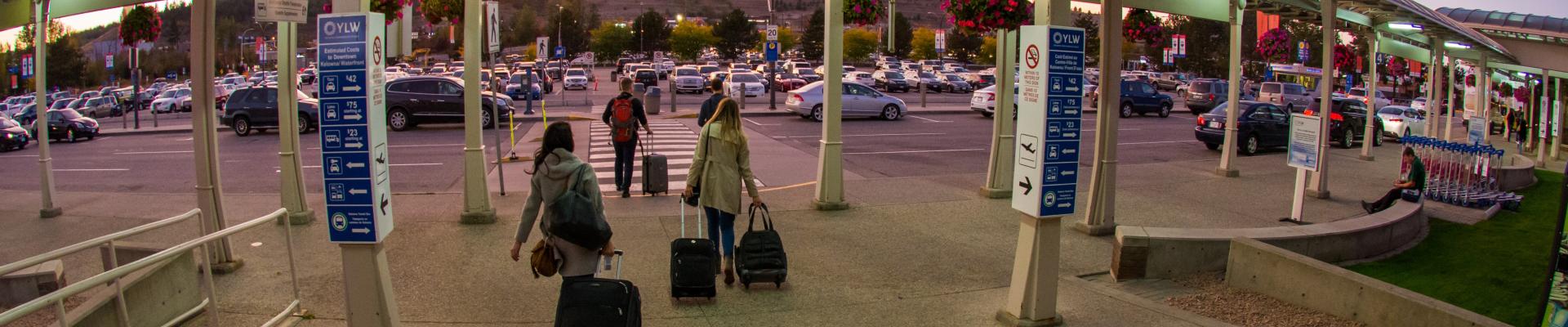
Assessment 3 (2025): The third assessment took a broader look at YLW’s property, examining whether unused land could support a ground-mounted solar array and evaluating the potential for solar canopies over the airport’s large parking lots. This assessment gives YLW the information they need to plan capital spending and funding applications for future implementation.
Results
The most direct result of the solar pre-feasibility assessments is the installation of solar panels on YLW’s Operations & Emergency Services Building (OESB), a tangible step in the airport’s decarbonization journey, made possible by the first assessment. YLW was recognized at the Airports Council International 2025 Annual General Assembly for achieving ACA Level 3, with rooftop solar cited as one of the actions driving that milestone.
Beyond the installation itself, the three assessments have given YLW’s planning and capital teams a clear picture of what solar could look like across their property. Each report provides leadership with an analysis they can bring to internal stakeholders, use to support funding applications, and reference in capital planning cycles, without requiring significant time investment on the client side to produce. Synergy also researches funding opportunities to assist with implementation costs, using the completed assessment work to position clients as stronger applicants for capital grants.
Key Takeaways
High Value, Light Lift
Synergy can typically complete a thorough assessment within a short timeframe, with minimal data-collection requirements from the client. Yet the output of emissions-reduction estimates, financial modeling, site comparisons, and funding recommendations provides organizations with a rigorous foundation for decision-making. It’s a small deliverable that can start the conversation for large decarbonization opportunities.
Airports Are Prime Candidates for Solar
Airports have structural advantages that make solar particularly worth exploring with the right planning. The properties tend to be large, with open, unobstructed land and rooftops well-suited for panel installation. As organizations with growing electricity demands and firm decarbonization commitments, the financial and carbon case for solar is often compelling, especially in sunny regions like Kelowna.
Right-Sizing Matters
One practical insight from YLW’s assessments is whether or not to create an oversized array to sell energy back to the grid. While this may be smart in other areas, in BC, sending surplus electricity back to the grid through net metering generates credits rather than revenue; right-sizing the system to airport demand is important. This means that at this point in time, there’s limited benefit in building a system much larger than the airport’s own consumption needs. Synergy’s approach ensures every assessment is sized to match actual demand, optimizing return on investment without over-engineering the solution.
A First Step Worth Taking
A solar pre-feasibility assessment is one of the most accessible ways for an organization to begin a serious conversation about renewable energy. It doesn’t require a major commitment, and it produces something concrete and useful regardless of whether implementation follows. For YLW, it started with one question and has since shaped a multi-year approach to solar energy across the entire campus.
Interested in exploring solar for your organization? A solar pre-feasibility assessment is a practical, low-cost way to understand what’s possible. Contact us to get started.