This blog was written by our Technical Lead, Kyle Bouwknecht
Key Takeaways
- Critical minerals are the fundamental requirements of the clean energy transition. Demand for copper and other critical minerals is rising as renewable energy, electric vehicles, batteries, and power grids expand globally
- Copper is essential for decarbonization, but copper mining must decarbonize too. Low-carbon copper production will be key to ensuring the materials behind clean technology align with global climate goals.
- Reliable emissions measurement is the first step toward low-carbon mining. Standardized carbon accounting and clear system boundaries help mining companies benchmark performance, reduce selective reporting, and build actionable decarbonization strategies.
- The biggest opportunities for reducing copper mine emissions are already clear. Renewable electricity, energy efficiency, electrified mining equipment, alternative fuels, and supply chain engagement can significantly lower greenhouse gas emissions from copper production.
- Mine waste recovery and legacy site remediation can produce low-emissions copper. Innovative approaches such as recovering metals from tailings and legacy mine sites can produce valuable critical minerals while supporting environmental restoration.
There’s a quote that’s been floating around for a long time that says that if a material wasn’t grown, it was mined. This may be a bit of a generalization, but the central message holds: without mining, we don’t have access to many of the materials that we use today. This is especially true when applied to the landscape of the clean energy transition. According to the International Energy Agency, demand for critical minerals may as much as quadruple by 2040 as the world moves away from fossil fuels and toward renewable energy and electrification (IEA, 2021). While some of this demand will be met by recycling existing metals, the majority will need to be fulfilled by mining operations.
This reliance on mining is, by and large, unavoidable if we are to curb greenhouse gas (GHG) emissions as much as possible. The question then becomes: how do we make mining low-impact so that while it is contributing to the solution, it’s not also contributing to the problem?
The Big One – What Are the Emissions of Mining Copper?
The government of Canada has identified 34 minerals that it deems are essential for Canada’s economy, the clean energy transition, or as a strategic resource for global trading partners (Canada, 2022). They range from aluminum to zinc, each with a unique role to play. In this list, however, one mineral sticks out above the rest.
Copper is crucial for many of the central technologies that will enable a shift away from fossil fuels. Solar, wind, and hydro power all require large amounts of copper to supply energy, while electricity networks require it to deliver electricity, and EVs and batteries need it for energy utilization and storage. Put simply, we can’t decarbonize without copper.
So, to decarbonize we need copper, and to get copper we need to mine it, and mining copper releases GHG emissions. How many emissions? Data from The Copper Mark, an independent assurance framework for responsible mining, and the International Copper Association suggest an average emissions intensity of 5.9 tCO2e (tonnes of carbon dioxide equivalent) per tonne of copper produced, depending on the production pathway (The Copper Mark, 2024) (International Copper Association, 2023). To put that in perspective, 5.9 tCO2e is roughly equivalent to the GHG emissions produced by a gasoline-fueled car driving 32,000 km, and one tonne of copper is enough for about 11 electric vehicles (Copper Talk, 2026). Cumulatively, GHG emissions from primary copper mines are about 97 million tCO2e per year, about the same as the entire country of Portugal (European Commission, 2025).
While these emission estimates are high, the good news about an average is that there must be values that are lower than it. In this case, that means there are copper mines that can extract this essential resource in a way that’s far less damaging than many of their mining counterparts.
Measure to Understand: How Are Mining Emissions Measured?
Before we dive into what low-carbon copper mines are doing to reduce their emissions, we must understand what it takes to actually measure the emissions of copper, the different boundaries being used, and how to apply caution when drawing comparisons between different operations.
The average emissions intensity of copper mentioned earlier covers scope 1, 2, and certain scope 3 emissions. Without going into too much detail, that “certain scope 3 emissions” piece is the part to focus on. In GHG emissions accounting, what is included in the reporting is referred to as the System Boundary. These boundaries frequently vary and, in some cases, are determined arbitrarily based on what a company wishes to include. This is seen most often in scope 3 – indirect emissions that occur due to activities outside of the reporting company’s control – where emission sources may be selectively included or excluded for a whole host of reasons.
In an attempt to standardize boundary setting, the International Copper Association released Best Practices Guidance for Greenhouse Gas Measurements specific to copper production.
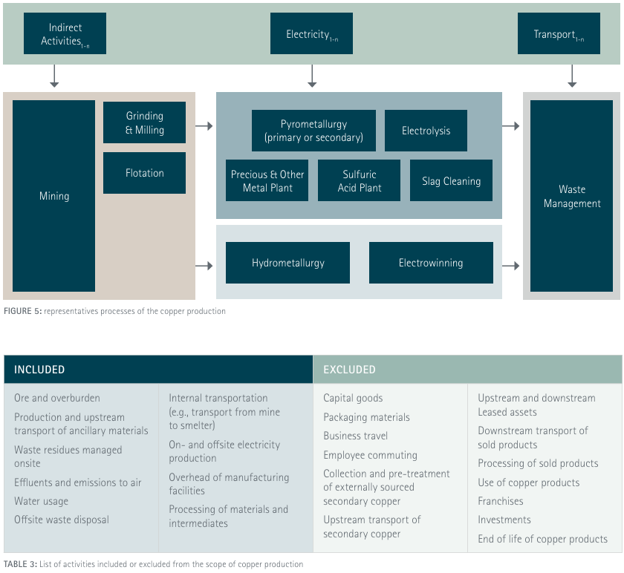 Figure 1: Suggested system boundary for harmonized carbon accounting of copper production (International Copper Association, 2022).
Standardized boundary setting is important for a couple of reasons. One, it provides a consistent framework that removes the guesswork of what should be included, eliminating the possibility of selective reporting. Two, it creates the opportunity for solid benchmarking and direct comparison between operations using the same boundary.
When considering how to decarbonize, it’s crucial to understand your emissions impact relative to similar operations. This is where benchmarks come in. Being able to compare your emissions against other mines that have measured using the same boundaries gives you an accurate picture of where you stand in the range of emissions profiles. Once you know where you stand, you can chart a path to reach your decarbonization goals.
How Do We Achieve Low-Carbon Copper?
Where GHG emissions come from in a copper mine are well understood. Scope 2 emissions from electricity consumption tend to account for between 33% and 50% of a mine’s total emissions (due to fossil fuels generating electricity), fuel consumed in mine equipment for between 15% and 30%, and scope 3 emissions make up the remaining emissions (International Copper Association, 2023; The Copper Mark, 2024). This split defines clear pathways for decarbonization:
- Reduce energy demand as much as possible through energy efficiency projects.
- Reduce the emissions intensity of the electricity supply via renewable energy projects.
- Use alternative fuels or electrification for mine equipment such as haul trucks, drill rigs, and excavators.
Engage supply chains to reduce scope 3 emissions from transport, smelting, and other outsourced activities. Let’s see what this looks like in practice.
The Northern Goldfields Facility in Australia is a 27.4 MW solar farm coupled with a 10.1 MW battery that produces enough electricity to cover about 12% of the mine’s electricity demand.
The Raglan Mine in northern Quebec has two wind turbines on site that provide about 10% of the mine’s electricity. Expansions are underway and up to 12 additional turbines are planned to be installed, along with battery storage that together would produce 42% of the mine’s electricity demand and would reduce diesel consumption by over 16 million litres of fuel per year.
Freeport-McMoRan has reduced energy consumption by 20% by switching to high-pressure grinding rolls in its operations (International Copper Association, 2023).
The Borden Gold Project in Ontario uses a fleet of all-electric underground mining equipment to replace diesel, eliminating combustion GHG emissions underground and reducing ventilation requirements and the associated energy consumption.
RioTinto switched to using 100% renewable diesel at its Boron operation in California for all its heavy machinery. This switch reduces GHG emissions by up to 45,000 tCO2e per year.
RioTinto’s Kennecott Copper project shut down its coal-fired power plant, instead building two solar plants and increasing its purchases of renewable energy from the electricity grid. The mine has also deployed all-electric underground mining equipment and started using renewable diesel for its heavy equipment in 2024.
Novel Approaches: How Have Companies Reduced Emissions From Mining?
More and more mines are realizing the benefits of energy efficiency projects, utilizing on-site renewable energy, and fuel switching to reduce both emissions and operational costs. Because of this, the practice of low-carbon mining is becoming more commonplace. Some operators, however, have decided to take completely different routes to copper extraction, routes that promise drastically reduced GHG emissions.
Minera Valle Central (MVC) is a Chilean company that specializes in recovering metals, primarily copper and molybdenum, from mine tailings. MVC’s approach manages and treats mine waste while beneficially extracting metals that would otherwise have been left behind. Mine tailings can have significant negative impacts on the environment due to heavy metals leaching, among others (Deepika et al., 2025), so MVC’s method not only produces valuable metals, it also contributes to site remediation.
Sasquatch Resources, located on the west coast of Canada, works on mine sites that have been closed for over a century and were never remediated. These sites contain large piles of untreated ore, resulting in significant environmental degradation, halting the growth of plants and trees, and leaving behind barren hillsides. Sasquatch has identified that these piles of ore contain significant quantities of recoverable metals, so its approach aims to process the remaining ore piles, extract the remaining metals, and remediate the site, allowing for recovery and regrowth of the local environment.
Other Dimensions of Low-Impact Mining
While this blog focuses on emissions, it must be said that this is only one piece of what makes a mine truly low-impact. Building a genuinely responsible mine means avoiding sites with deep ecological or cultural significance, high conservation value or fragile biodiversity, and engaging meaningfully with Indigenous communities to respect their rights, including free, prior, and informed consent where a project affects their territory. These considerations are as fundamental to building a low-impact mine as emissions reductions.
Conclusion
Copper is central to the clean energy transition, but the way it is extracted will determine whether it accelerates the clean energy transition or undermines it. As demand for critical minerals rises, mining companies, policymakers, and customers need clear emissions measurement, comparable benchmarks, and practical pathways to reduce impacts across electricity use, equipment, fuels, and supply chains. The examples highlighted here show that lower-carbon copper is already possible through renewable energy, electrification, energy efficiency, alternative fuels, and innovative recovery from existing waste and legacy sites. Meeting future copper demand responsibly will require scaling these solutions quickly so that the materials enabling a low-carbon economy are produced in a way that reflects the same climate goals they are meant to support.
If you’re working on a critical mineral project and want expert guidance on low-impact operations, Contact Us.
References
Canada. (2022, April 7). Critical minerals: An opportunity for Canada [Campaigns]. https://www.canada.ca/en/campaign/critical-minerals-in-canada/critical-minerals-an-opportunity-for-canada.html
Copper Talk. (2026, March 2). EV Battery Copper Demand: How Much Copper Per Electric Vehicle? https://coppertalk.org/blog/ev-copper-demand-per-vehicle-2026/
Deepika, Tyagi, A., & Haritash, A. K. (2025). Environmental impacts of mine tailings and phytoremediation as a sustainable management strategy: A review. Acta Geochimica, 44(5), 1142–1165. https://doi.org/10.1007/s11631-025-00804-8
European Commission. (2025). GHG emissions of all world countries: 2025. Publications Office. https://data.europa.eu/doi/10.2760/9816914
IEA. (2021). Mineral requirements for clean energy transitions – The Role of Critical Minerals in Clean Energy Transitions – Analysis. IEA. https://www.iea.org/reports/the-role-of-critical-minerals-in-clean-energy-transitions/mineral-requirements-for-clean-energy-transitions
International Copper Association. (2022). Carbon Footprint of Copper Production. https://internationalcopper.org/wp-content/uploads/2022/10/ICA-GHG-Measurement-202210-Final-Spreads.pdf
International Copper Association. (2023). Copper—The Pathway to Net Zero. https://internationalcopper.org/wp-content/uploads/2023/02/ICA-GlobalDecarbonization-202301-Final-singlepgs.pdf
The Copper Mark. (2024). Decarbonizing the Copper Sector. https://coppermark.org/wp-content/uploads/2024/05/CopperMark_DecarbonizingTheCopperSector_2024.04.18.pdf