Client Name
Shift Technologies
Industry
Software
Location
Victoria, B.C.
Client Size
Medium
Website
Services Offered
- Annual Greenhouse Gas Inventory
- Technical Advisory on Digital Emissions Methodology
- Communication Advisory around Carbon Neutrality
- Carbon Offset Procurement Support
Challenge
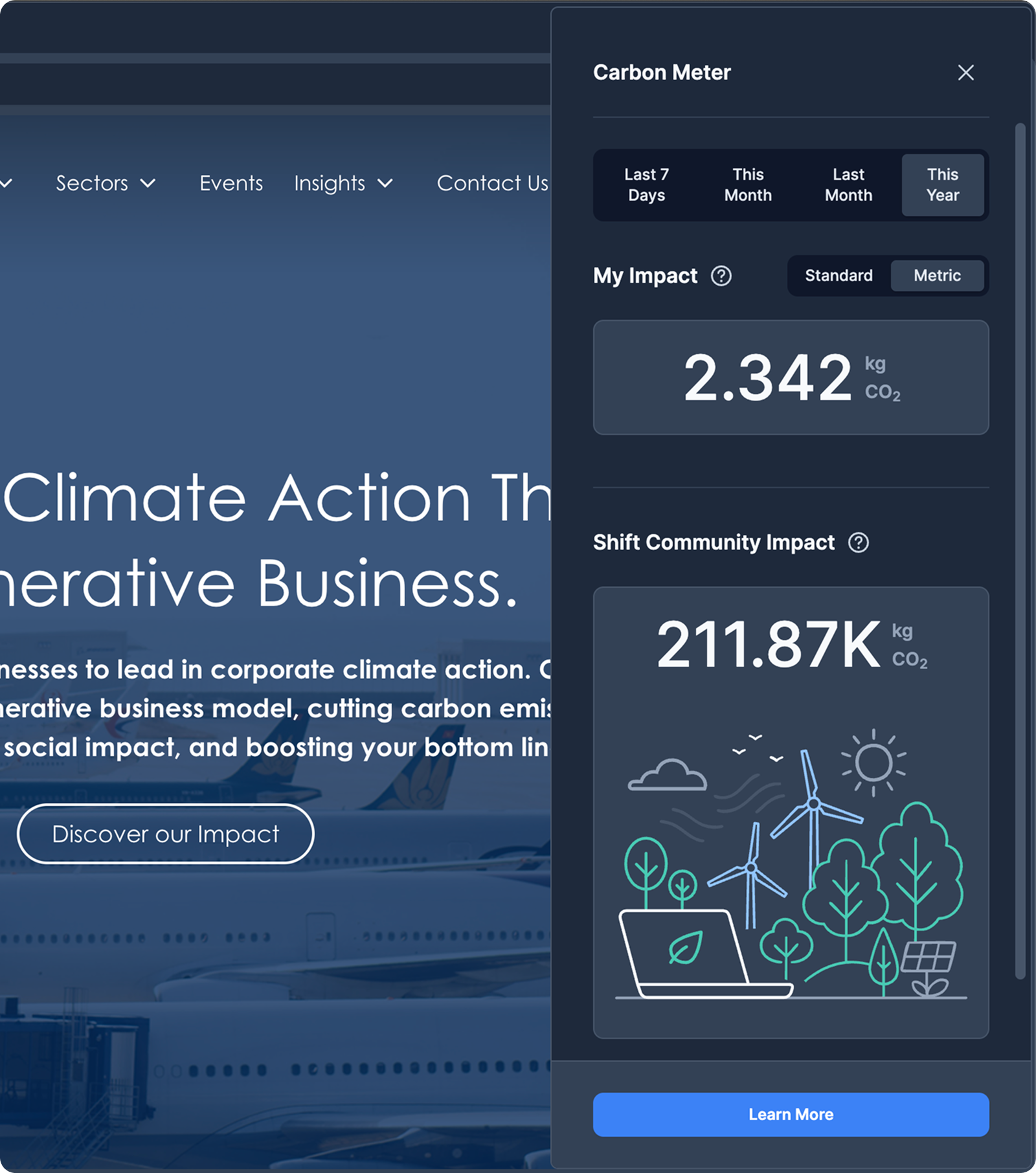
Shift browser, created by Shift Technologies, a company within the Redbrick portfolio, is designed to enhance productivity and reduce digital clutter. In 2025, with a new product launch, Shift released the Carbon Meter, a built-in tool to calculate users’ digital GHG emissions associated with their browsing activity when using the Shift browser.
They wanted to integrate sustainability into everyday operations and lead the tech industry to better understand digital carbon emissions from browsing. The first step in doing this was to find a way to measure its GHG footprint from corporate operations, as well as the emission impact of users browsing the internet through its browser. They had already begun developing the Carbon Meter feature that would track real-time emissions from user browsing activity. However, due to the highly specialized nature of the project and lack of in-house carbon accounting knowledge, Shift was seeking a partner to support them in GHG accounting, marketing and communications advisory services, and overall sustainability. Shift collaborated with Synergy to gain technical expertise, ensuring its application of the Sustainable Web Design Model (SWDM) aligned with best practices for carbon reporting.
In addition, Shift wanted to become the first carbon-neutral browser. With regulations on climate-related claims becoming stricter, Shift wanted to find a balance between proudly communicating its environmental initiatives while not being accused of greenwashing.
The Core Challenges Included:
- Validating their Carbon Meter methodology based on the Sustainable Web Design Model (SWDM)
- Conducting a comprehensive Annual Greenhouse Gas Inventory (AGI) that included Category 11 (use of sold products) emissions from their digital products
- Developing a communication strategy for carbon neutrality claims that aligns with evolving regulations.
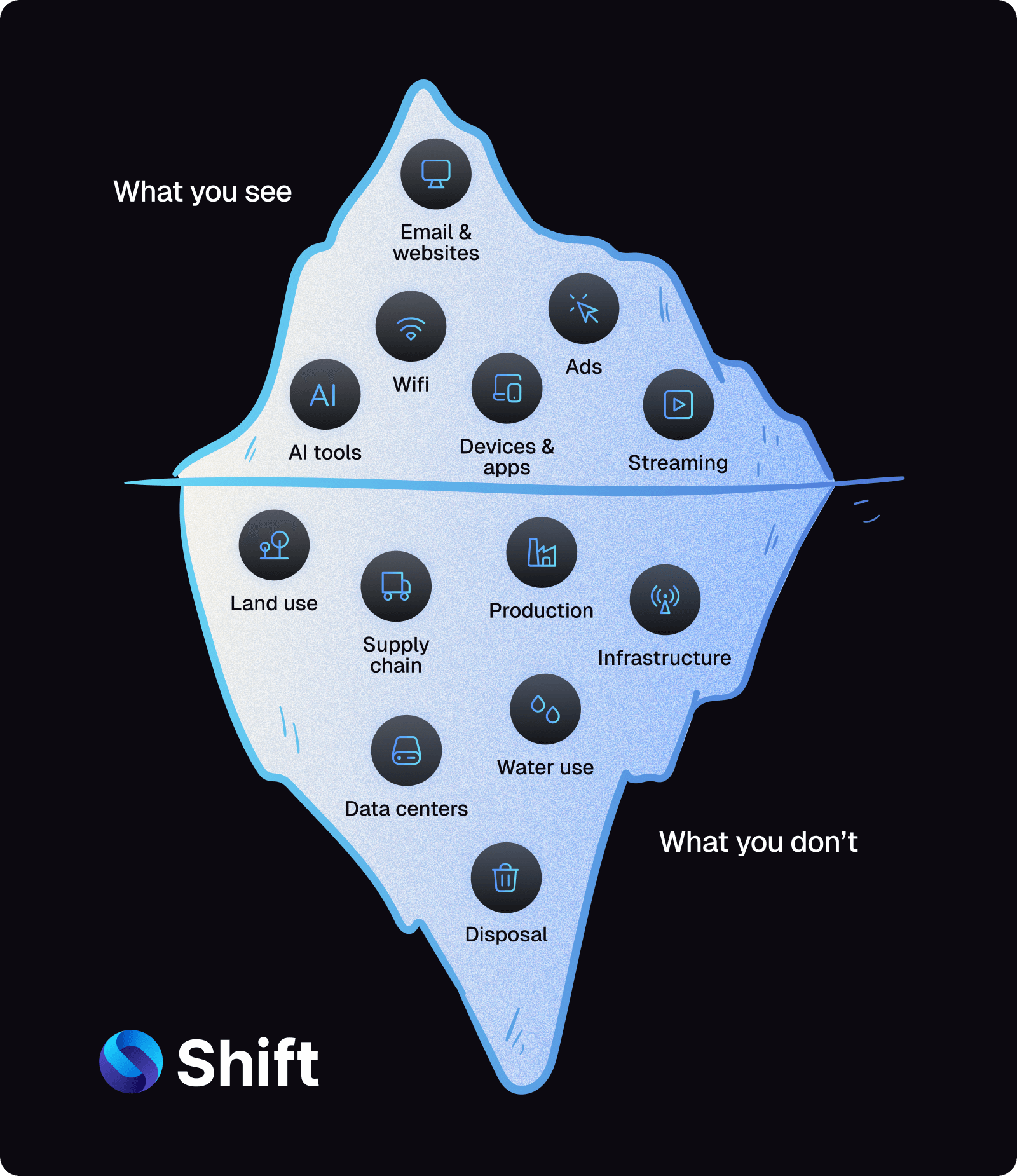
Measuring digital emissions is an emerging practice that is more complex than measuring the emissions for traditional products, as the environmental impact depends on numerous variables, including end-user devices, network infrastructure, data center efficiency, and grid electricity sources across different geographic locations.
Synergy’s Solution
Technical Advisory and Methodology Validation
Synergy provided expertise in carbon accounting guidance to support and refine Shift’s application of the SWDM digital emissions methodology. The SWDM was selected and implemented by Shift, and proposes a methodology for measuring digital emissions. The SWDM uses a top-down approach, estimating global data transfer volumes and corresponding energy consumption to create conversion factors for emissions per gigabyte of data transferred. While acknowledged as the best available methodology, measuring digital emissions is a complex and evolving practice that will result in improvements over time.
Implementation Process
Synergy worked with Shift to:
- Review and validate their Carbon Meter calculations against the Sustainable Web Design Model
- Provide recommendations for improving methodology accuracy, particularly regarding geographic location factors related to energy consumption.
- Incorporating the Category 11 emissions from browser usage in the company’s GHG inventory
- Reviewing communications copy for accuracy and language use around GHG reporting and carbon neutrality.
- Advise on a carbon-neutral communication strategy and the integration of sustainability into Shift’s value proposition.
- Support with carbon offset project selection and communication of offset strategy.
Dual Measurement Challenge
A unique aspect of this project involved simultaneously measuring corporate emissions and the impacts of digital products. Synergy collaborated with Shift to define the boundary between the companies’ GHG inventory (which includes the use of sold products) and the measurements recorded by the Carbon Meter, ensuring accurate boundaries and preventing double-counting while maintaining the integrity of both measurement approaches.
The Results
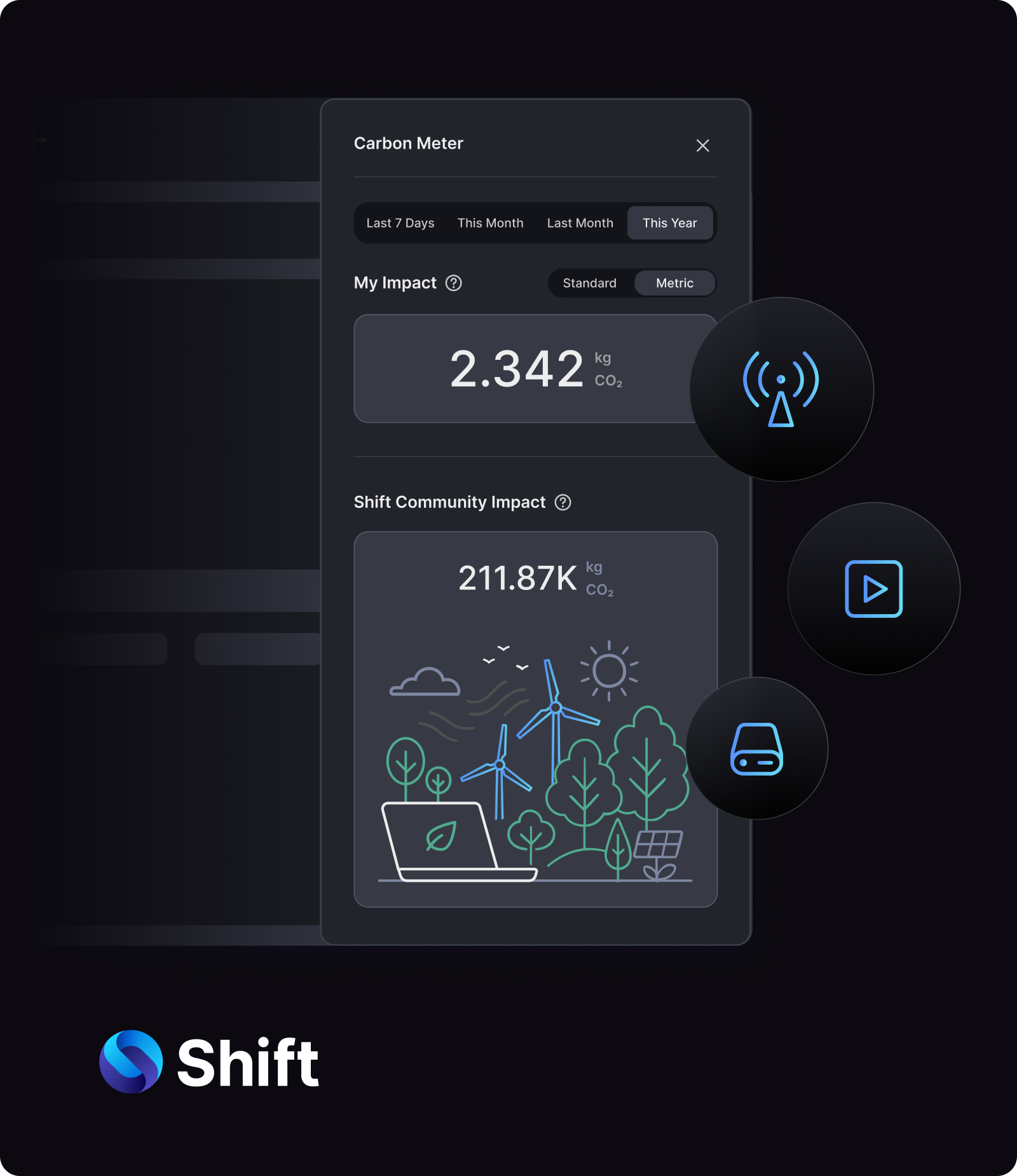
Synergy provided technical expertise on aligning Shift’s Carbon Meter methodology and offered recommendations to enhance the tool’s emission measurement accuracy. The Carbon Meter now provides users with real-time transparency about their browsing emissions, making Shift one of the first browsers to offer this level of environmental transparency.
The full scope 3 GHG inventory established Shift’s corporate emissions, enabling them to purchase carbon offsets and achieve their goal of becoming a carbon-neutral company.
Product Launch and Impact
Shift launched its browser, with integrated Carbon Meter functionality, making it one of the first browsers to offer real-time emissions tracking. Shift plans to offset emissions every quarter to maintain its carbon-neutral browser status.
Communication Strategy
Synergy advised Shift on its carbon neutrality messaging to ensure it closely aligns with evolving regulations. Synergy advised on terminology, substantiation requirements, and transparency to ensure Shift’s claims would withstand scrutiny against the evolving regulations around green claims.
Industry Leadership
This assessment provided Shift with deep insights into the origins of browser emissions, enabling them to begin thinking about how to reduce emissions. While companies like Shift cannot control the efficiency of end-user devices or network infrastructure, they can make intentional choices about data center locations and aim to host their activities in regions with electricity grids powered by renewable sources. This highlights an important insight for the broader tech industry: some websites and digital experiences are more emissions-intensive than others. User education and conscious internet usage should be a focus for the tech industry to reduce tech-related emissions.
Key Takeaways
Pioneering Digital Sustainability
Shift demonstrated remarkable leadership by tackling digital emissions measurement when few resources or established practices existed. When they couldn’t find adequate studies on browser environmental impact, they developed their own measurement tool, advancing the technical knowledge base for the entire industry.
Decarbonization Insights
One key decarbonization insight from this project is that renewable energy grids have a significant impact on data center emissions. While companies cannot control where end users are located, they can be strategic about data center and hosting locations to minimize their carbon footprint.
Building Partnerships to Become Climate Action-Oriented
Shift demonstrated that you don’t have to be an environmental company to create a meaningful climate impact. Shift leveraged their technical expertise to tackle digital emissions measurement in an emerging field, partnering with Synergy’s carbon accounting knowledge to advance climate action. By focusing on the right partnerships and applying their development competencies to climate challenges, any business can advance environmental progress in its industry, even when established practices don’t yet exist.
Interested in advancing climate action in your industry? Contact us to start your decarbonization journey